
Germs and Cavities
Are germs really the cause of cavities? Modern dentistry would have us believe that bacteria are the cause of tooth decay. If this is true, then the only way we are empowered to stop tooth decay is to stop the bacteria. Yet stopping bacteria is unrealistic, since they are everywhere, billions of them. Stopping bacteria should be easy with antibacterial treatments but for some reasoson it never works...
Germs seem to be blamed for everything from foot fungus, to colds, to dental plaque. Dental plaque, caused by germs, is supposed to be the basis of tooth deterioration and gum deterioration.
The origin of the germ theory of disease came from Louis Pasteur. Hailed as one of the most important discoveries of modern science, he supposedly found the real cause of disease. The germ theory is the belief that disease arises from microorganisms outside of the body, these microorganisms do not change or mutate, but rather they inadvertently penetrate the body's defense mechanisms and infect the host.
The problem with the germ theory is that germs now become a scientific mask for what people once believed caused disease: "evil spirits". The problem with the "evil spirit", that is, the evil little microscopic things we cannot see (germs) theory, is that the victim (everybody) is powerless to stop the disease.
Are germs really the cause of tooth decay and gum disease? Or are germs concomitant to disease; are they simply present in different forms in disease and in health?
Lactobacillus Acidophilus
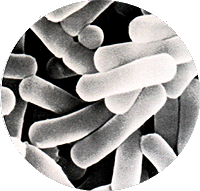
Lactobacillus Acidophilus is one of many bacteria in the genus Lactobacillus.
lacto- means milk
bacillus means rod-like in shape,
and acidophilus means acid-loving.
Lactobacillus Acidophilus means Milk Rod Shaped Acid Loving Bacteria
L. acidophilus is considered by some, a probiotic or "friendly" bacteria. The Modern Theory -
The claim is that the bacteria L. acidophilus combine with proteins that are found in saliva and food debris, forming plaque. The assumption is that bacteria filled plaque then go about digesting sugary and other easily digestible foods. After the L. acidophilus has finished eating, they excrete an acid. If there is enough L. acidophilus excreting acid in one area, then the calcium can get dissolved. Once enough tooth enamel is removed, there is a groove. In this shallow hole, the lactobacillus acidophilus positions itself on the groove, and begins the process of tooth decay.
I do not believe this is an accurate theory; I explain how germs do not cause tooth decay in my book.
Rather than focusing on removing germs, it would be a good idea to focus on providing nutrients to your teeth and gums. One excellent way to provide topical nutrients is with a natural herbal mouthwash, the link goes to one that I personally use.
Streptococcus Mutans
Genus: Streptococcus
Species: mutans
Gram-positive spherical bacterium.
Sugar, saliva, and bacteria lead to a formidable combination that supposedly leads to tooth decay. Streptococcus mutans adhere to the glycoprotein. Supposedly they produce acid which eats away at tooth enamel after sugary snacks.
Are these small tubes and spheres really the cause of tooth decay? If so, why does tooth decay seem to get worse with age?
Learn about tooth decay prevention >>
I had several very painful cavities postpartum (after having twins) that kept me up all night in pain and made it so I could barely eat... After following the advice in this book accruately my tooth pain subsided within 24 hours and no longer hurt at all, my teeth also look nicer and my gums no longer bleed and are a nice pink color. -J. Steuernol, Canada

"The practical advice in this book really seems to be reversing my tooth decay!!! Hallelujah brother!!! The dentist wanted me to have two major root canals immediately and two other teeth filled. When I asked him if there was anything I could do with nutrition or supplements to get mu teeth to heal, he said "maybe you could slow the decay down a little bit" but that essentially the answer was no.
That dental visit was three mobnths ago and my teeth have stopped aching all together, are way less temperature sensitive, and feel generally stronger.
Most of us have been totally disempowered regarding the health of our teeth. This information has changed that for me. I bought the book for $28 anyway though. What a bargain, The dental work was going to cost well over $4000.00 no wonder dentists don't seem open to this stuff working! Talk about a biased perspective!!!
Think I'm excited, you will be too if you use this info to take tooth health into your own hands!"
Very satisfied, Mike - Ashland, OR
"Not only is Cure Tooth Decay a practical guide to teach parents how to raise healthy children (with healthy teeth), it is also a helpfull tool for adults who have suffered with poor dental health and/or chronic disease. I would also highly recommend this book to people who are looking for things they can do to protect their bones, and their overall health, as they age. In other words, this book is a must read for everyone interested in improving their health." Pam Killeen New York Times nestselling Author
"Ramiel, You (along with Weston Price) saved my teeth. Was supposed to get a root canal (which I had no money to pay for). Tooth was in pain. After three weeks on the diet I can feel a big difference, tooth doesn't hurt now and feels like it's healing. Thanks so much. Unbelievable!" - Leroy, Utah
My cavity has gotten smaller! Once you are set free from being a slave to modern foods of commerce author continues to explain how the ancient people ate. They were healthy, strong and good looking. They had no cavities. They had no illness until familiar western culture came to visit them. If you are reading this review I am sure you understnad something is not right in the world. That we are born to live under a certain hypnosis. That we are taught to give away our responsibility to "people with authority", and those people cannot even take care of themselves. I recommend this book if you want the way out."Ranko, Croatia

