
Early Childhood Caries - Alternative Explanation
Early childhood caries (ECC) is dental caries on the first teeth of the child.
Overview of ECC
Early childhood caries often affects poor and minority populations. The common paradigm claims that the way to prevent it is through behavioral and educational programs that advocate individualistic changes so that parents and caretakers can detect and avoid the recurrence of caries in their children.
A Review of ECC Literature
Unfortunately many of these methods do not work.
"For the last fifty years, dentists and researchers have struggled to clearly define ECC — it has been referred to as “baby bottle tooth decay,” “nursing bottle syndrome,” and “rampant caries lesions” (Huntington, Kim, & Hughes, 2002)." - Source: JYI
Researchers have had problems defining ECC because they are looking past the real problem: a nutrient deficiency. The correct definition is pedia-ondoclasia. Child-tooth loss.
"Overall, defining ECC is problematic because the true nature of the syndrome is not clear." - Source: JYI
The true nature of the syndrome is clear, as Weston Price documented its causes and published it in several dental journals: improper nutrition is the cause of early childhood caries.
"Untreated caries may lead to early loss of the primary dentition and affect the growth and maturation of the secondary, adult dentition." - Source: JYI
It appears that cavities in the first teeth affect the second, but in fact they do not. However, if the cause of the cavities is not addressed in the first set of teeth, the second set of teeth will also develop cavities for the same reasons the first ones did.
Conventional ECC Treatment
Typical dental treatment involves fillings, steel or veneer crowns, in which a cap is fitted on the tooth.
Tooth decay in children is usually painless until the decay reaches deep into the pulp. If the decay is left untreated, an infection can develop as food from the mouth enters into the tooth pulp.
The "restorative" treatments are painful and scary for young children because they cannot understand what is happening.
Preventative Measures That Don't Work
Fluoride - a deadly poison, does not prevent tooth decay. Large and longer term studies show that fluoride use increases, rather than decreases, tooth decay. Why do children still get cavities in fluoridated communities if fluoride works? If fluoride really worked, all the dentists in fluoridated cities would go out of business because they would have so few customers.
Dental Sealants - They can provide temporary protection against tooth decay. Dental sealants wear out and commonly release toxins into the child, such as BPA.
Child Tooth Decay Prevention That Does Work
Dietary Practices - Frequent use of sugar will contribute to tooth decay because it causes minerals to be pulled from the bones. Raw grass-fed cows' milk and breast milk do not cause childhood tooth decay. On the contrary, human breast milk, and raw animal milks from pasture fed animals prevent tooth decay by providing important vitamins and minerals to babies and children.
ECC is a Preventable Disease
You can prevent early childhood caries. Prevention really begins before conception, when the mother and father-to-be eat foods rich in fat-soluble vitamins and rich in minerals. The parents must also avoid and limit overly processed and denatured foods.
The diet at this time sets the stage for whether a child is susceptible to early childhood caries or not. Even still, a good diet after birth will prevent cavities. Your children's real teeth are priceless.
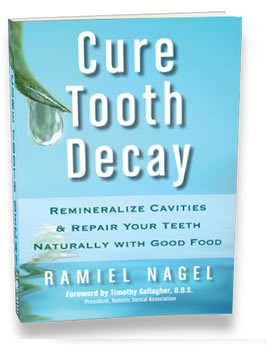
Learn how to prevent your child's tooth decay. I have a special section on overcoming children's tooth decay in my book, "Cure Tooth Decay."
Purchase Cure Tooth Decay!
"I've always known deep down that teeth can heal naturally. When my own daughter began having dental issues, I went on a mission! Already been down that path, and being very scarred from the dental experiences I endured, I knew I couldn't put my child through it. I found Dr. Weston Price's research and my instincts told me this was it! Ramiel has now written a book, drawn from Price's findings, but specifically directed at restoring dental health. The result is a very comprehensive book that lays it all out. He is honest. And the truth is an incredible eye-opener! The protocol works. Get this book, especially if you have children."-Mrs. Brown, Canada

"Not only is Cure Tooth Decay a practical guide to teach parents how to raise healthy children (with healthy teeth), it is also a helpfull tool for adults who have suffered with poor dental health and/or chronic disease. I would also highly recommend this book to people who are looking for things they can do to protect their bones, and their overall health, as they age. In other words, this book is a must read for everyone interested in improving their health." Pam Killeen New York Times nestselling Author
Fabulous book! I work in a health food store and will be recommending it a lot. - Vimala
I purchased your cure tooth decay book and appreciate all the info that has opened my eyes to this nutritional healing. - Ace
I have read your book and I am very grateful for it. Thank you for all your hard work! - Joni

