
Weston Price - That a Clean Tooth Does Not Decay and that Mouth Cleanliness Affords the Best Known Protection Against Dental Caries.
|
Dental Cosmos Page 871 1934 Oral cleanliness is not the best known means for the control of dental caries because: (I) It is not Nature's method. (II) Immunity and susceptibility can be clinically altered at will be modifying the nutrition. (IV) Tooth decay is not a disease, but a symptoms, like many other degenerative processes. |
(I) Since primitive man has had high immunity to dental caries he becomes our control in the great experiment of civilizations.
It is essential there fore, that we study the controlling factors of his environment, of which he is the product, and use these as our yardstick for studying modern civilization.
For this I have studied remnants of several primitive racial stocks where their physical isolation had sheltered them from the influences of our modern civilization, and by studying them and their foods and their methods of living, certain underlying factors.
are found to be common to all these primitive groups, even though they were living in different countries and on very different foods. This permits us to critically analyze modern civilizations at their points of contact with the primitives and, by studying them and their problems with the standards of immune primitives, not the factors which are contributing to dental caries.
By studying the children in four isolated valley in Switzerland; Loetschental, Visperterminen, Grachen, and Ayer in the Swiss Alps, I found the incidence of dental caries to be only 4.6 percent of the teeth studied. Here oral prophylaxis and modern equipment for practicing it were largely unknown. At St. Moritz, however, at approximately the same altitude, which is highly modernized community with excellent training in oral prophylaxis, the incidence of caries was 29.8 per cent of teeth studied.
At Vissoie and Zinal, which were partially modernized, 22 percent of the teeth examined had been attacked by dental caries. At Herisau, in the plains country of Switzerland, also a highly modernized community with splendid instruction and equipment for mouth cleanliness, the incidence of cares was 24.7 per cent of the teeth examined.
Similar studies were made in the Outer Hebrides off the west coast of Scotland and revealed that in the isolated districts of the Isles of Lewis and Harris, only 1.2 percent of the teeth examined has been attacked by dental caries. Oral prophylaxes was almost unknown. In the ports and modernized sections the incidence of dental caries was found to be 30 per cent of teeth examined.
The natural foods available for these two primitive groups wee very different in origin, but similar in chemical content, as will presently be shown.
Similarly, studies were made of remnants of the primitive Eskimos and Indians of Alaska and northern Canada and of those individuals of these groups who are at the point of contact with modern civilization.
The Eskimos of western and northern Alaska were reached by airplane and for several groups who had been but little influenced by modern civilization, hence living entirely on native foods, the per cent of teeth found to have been attacked by dental caries was 0.09, that is, only two teeth out of 2138 in seventy-two individuals. No effort apparently had ever been made at oral prophylaxis in these groups.
At the point of contact with modern civilization, where a government supply boat comes once a year to provision a government state, the incidence of caries among the local Eskimos increased to 13 per cent of the teeth, or 394 teeth out of 2254 in eighty-one individuals. At this point oral prophylaxis was being taught and practiced and, in spite of it, the increase in dental caries was 144-fold. The controlling factors in producing these changes will presently be shown to be nutritional. The natural food of the primitive Eskimos was almost entirely the animal life of the sea.
Similarly, quite primitive Indians were sought for and found in northern Canada who were living practically entirely on wild animals. Their physical isolation from the influence of modern civilization was very complete. Three groups were found, consisting of seventy-six individuals with 2144 teeth and without a single tooth having been attacked by dental caries. In a total of 2464 teeth examined for eighty-seven individuals in four groups, only four teeth had ever been attacked by dental cries, or 0.16 per cent.
These people knew nothing of oral prophylaxis as understood by modern civilizations.
For the groups of these Indians at the point of contact with modern civilization, 21.5 per cent of 1878 teeth in seventy individuals, or a total of 405 teeth, had been attacked by dental caries. This is an increase of 134-fold. These individuals had been taught oral prophylaxis.
More About the Connection Between Diet and Teeth
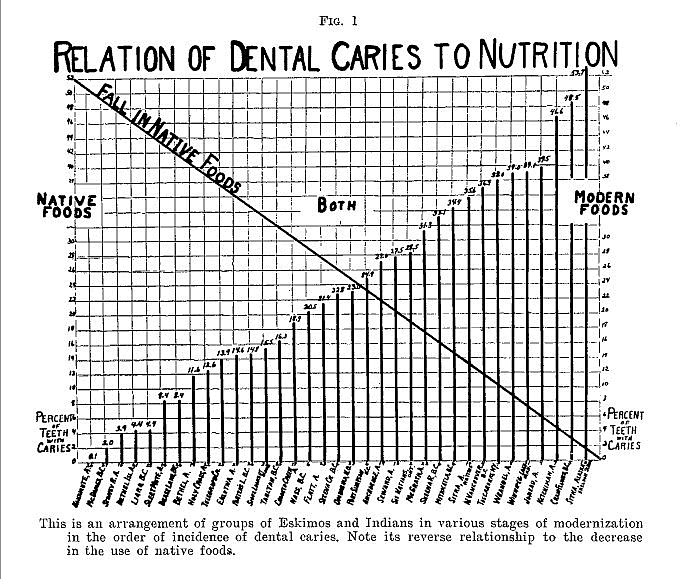
When we arrange the incidence of dental caries according to the degree of contact with modern civilization and its foods beginning with the coast towns and settlements of the Pacific coast of Canada and Alaska, including Wrangell at the mouth of the Stikine River, from which connection is made with Telegraph Creek up the Stikine River by boat in the summer and then by trail over the Rocky Mountain Divide into the Interior, we find that the percentage of teeth involved for seven coast settlements for all individuals for all groups studied is 40.8; Telegraph Creek, 14.9; Dease Lake, just over the divide, the first inside Hudson Bay Post, 9.6 per cent; and McDames and Liard, the two Hudson Bay Posts farthest in the interior, 3.1. For the most isolated and primitive of these last two groups of 0 per cent of teeth had dental caries.
This is shown graphically in Fig. 1 for twenty-four places which reveal the relation of caries to nutrition. Knowledge of and equipment for oral prophylaxis are in the direct proportion in these groups with the incidence of dental caries, and dental caries is in direct proportion to the displacement of native foods with modern foods.
Accordingly, since the incidence of dental caries is shown to be in direct proportion to the utilization of modern foods to displace the native foods, we are concerned to know the chemical or physical qualities of the foods which constitute the controlling factors. Large numbers of the samples of foods are collected for chemical analysis to provide this information.
 Part two of this article continued here.
The practical advice in this book really seems to be reversing my tooth decay!!! Halleleuiah brother!!! I bought the book for $28... What a bargain, The dental work was going to cost well over $4,000.00 Think I'm excited, you will be too if you use this info to take tooth health into your own hands! Very satisfied. - Mike in Ashland, Oregon.

This book is a must read for everyone interested in improving their health. - Pam Killeen, NY Times bestselling author
I had several very painful cavities postpartum (after having twins) that kept me up all night in pain and made it so I could barely eat... After following the advice in this book accurately my tooth pain subsided within 24 hours and no longer hurt at all, my teeth also look nicer and my gums no longer bleed and are a nice pink color. - J. Steuernol, Canada
AWESOME, AWESOME, AWESOME. - Jackie
Fabulous book! I work in a health food store and will be recommending it a lot. - Vimala
I purchased your cure tooth decay book and appreciate all the info that has opened my eyes to this nutritional healing. - Ace
[Cure Tooth Decay] is a vehicle towards a higher good. It changes your perception of reality. It changes the reality. - Ranko Medved, Croatia

